Promotional Calendars for Business: A Buyer's Guide
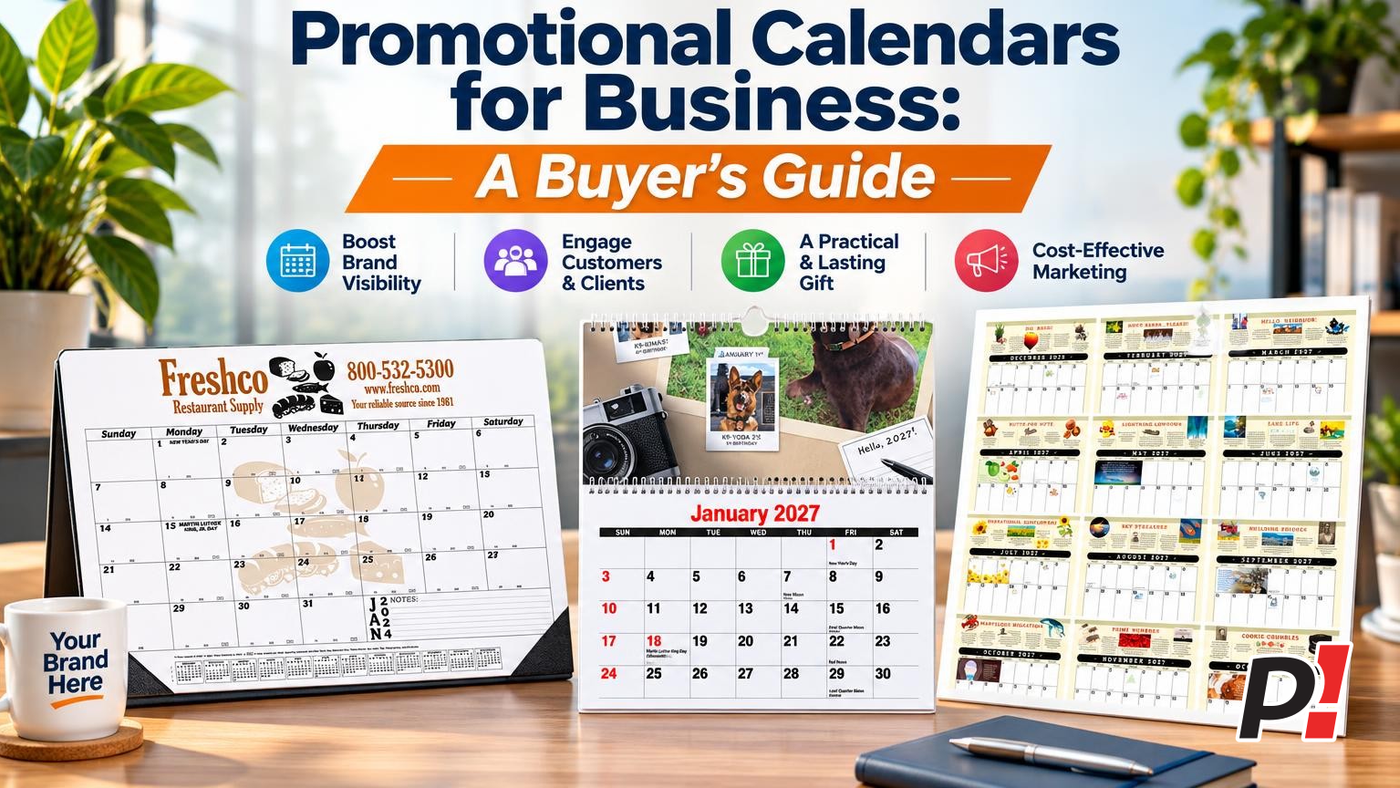
Promotional calendars for business remain one of the most enduring promotional products in the United States. Unlike a pen that runs out of ink or a tote bag that wears out, a calendar sits on a desk, hangs in a break room, or sticks to a refrigerator for twelve full months. Every time someone checks a date, your logo is there. That repeated exposure is why marketing directors, HR directors, safety managers, and small-business owners keep coming back to custom calendars year after year.
But ordering calendars is not as simple as picking a picture and a logo placement. There are wall calendars, desk calendars, magnetic calendars, planner styles, and calendar cards, each with its own decoration method, minimum order, and production timeline. Paper stock, binding, and imprint area all affect how your brand looks in a recipient's hands. Order too late and you miss the January window. Choose the wrong format and your calendar ends up in a drawer instead of on a wall.
This buyer's guide walks through the considerations that matter before you place a bulk calendar order: what the product is for and who orders it, what to look for in a supplier, how materials and quality affect longevity, decoration options, quantities and lead times, and the mistakes that trip up first-time buyers. By the end, you will know how to spec promotional calendars that people actually keep and use.
Popular Promotional Wall Calendars


What Promotional Calendars Are For and Who Orders Them
Promotional calendars for business are functional giveaways first and marketing tools second. Their job is to earn a spot in a workspace or home where they will be seen daily. That makes them different from a branded hat or T-shirt, which relies on the recipient wearing it in public. A calendar works quietly in the background, which is why it suits organizations that want long-term brand recall without an aggressive sales message.
Marketing directors often order custom calendars as part of a broader promotional mix. They pair wall calendars with branded pens, custom notepads, and promotional desk accessories to create a cohesive new-year gift for clients and prospects. The calendar becomes the anchor item that stays visible after the pens are gone. Marketing teams also use calendar cards as a low-cost leave-behind at trade shows, where a flat card fits easily into a bag and does not add weight.
HR directors use personalized calendars in employee appreciation programs and onboarding kits. A branded desk calendar on a new hire's first day signals that the company thought about the details. HR teams also order wholesale calendars for benefits fairs, wellness programs, and open enrollment events, where a calendar with key dates printed on it doubles as a reference tool. Company stores are another channel: calendars make sensible points-redemption items because they appeal to a wide range of employees.
Safety managers have a specific use case that many buyers overlook. Custom calendars can be printed with safety reminders, inspection schedules, or emergency contact information alongside the monthly grid. A calendar in a warehouse break room that reminds workers to check PPE before each shift does more than a poster that gets tuned out after a month. Safety teams order branded calendars for toolbox talks, safety committees, and annual training refreshers.
Small-business owners order promotional calendars for business as client gifts, referral thank-yous, and neighborhood giveaways. A local insurance agent, accountant, or contractor can hand out custom calendars to every client and prospect on their list and stay top of mind through tax season, storm season, or whatever cycle drives their business. Because minimums vary by product and are shown on each item, a small shop can start with a modest order and scale up as the list grows.
Other organizations that rely on bulk calendars include banks and credit unions, real estate offices, automotive dealerships, dental and medical practices, churches and community groups, schools and PTAs, and nonprofits running fundraising campaigns. Each has a slightly different audience, but the underlying logic is the same: a calendar is useful, so people keep it, and keeping it keeps your brand in view.
- Marketing directors: client gifts, trade show leave-behinds, campaign anchors
- HR directors: onboarding kits, employee appreciation, benefits fairs, company stores
- Safety managers: inspection schedules, safety reminders, training refreshers
- Small-business owners: client thank-yous, referral gifts, neighborhood giveaways
- Financial, real estate, automotive, and healthcare offices: annual client retention
Promotional Magnetic Calendars

Calendar House Magnet
Item # 512669 90A

2027 3 1/2" X 4" Pink Ribbon Process Color Magnetic Calendar
Item # 518123 90A

2027 4" X 7" Serenity Large Magnetic Calendar Process Color
Item # 518127 90A

Holiday Calendar Punch Out Picture Frame
Item # 528995
What to Look For in a Calendar Supplier
The first thing to evaluate is product range. A supplier that carries only one or two calendar styles will push you toward whatever is in stock. Look for a distributor that offers wall calendars, desk calendars, magnetic calendars, planner calendars, and calendar cards, so you can match the format to the audience. A magnetic calendar suits a homeowner who sticks it on the fridge; a desk calendar suits an office worker with limited wall space; a wall calendar suits a break room or reception area.
Second, ask about decoration capabilities. Calendars are typically decorated with screen printing, offset printing, or full-color heat transfer, and the method affects both appearance and durability. A supplier that can handle multi-color imprints and full-bleed images gives you more creative options. If you want a photo of your team or your building on the cover, confirm that the supplier can reproduce it at high resolution rather than a flat one-color logo.
Third, look at the proofing process. Calendar orders are usually placed months before the new year, which means errors are expensive to fix after production. A good supplier sends a digital proof showing imprint placement, colors, and any custom date callouts before the run starts. Ask whether revisions are included and how many rounds you get. For safety managers printing inspection schedules or HR teams printing benefit dates, proofing is not a formality; it is the step that prevents a warehouse full of calendars with the wrong phone number.
Fourth, confirm the production calendar. Calendar season runs from late summer through early winter, and presses fill up. A supplier that communicates cut-off dates for holiday delivery and guarantees in-hands dates helps you plan your distribution. If you need calendars for a January trade show, you want a supplier who can commit to a ship date in writing, not one who says "should be fine."
Fifth, evaluate the supplier's experience with bulk orders. Promotional calendars for business are usually ordered in larger runs than single-item gifts, and the logistics differ. You want a supplier who understands split shipments to multiple offices, individual poly bagging for mailers, and consolidated invoicing for multi-location orders. Ask how they handle drop shipping and whether they can include a packing slip with your branding.
Finally, consider the supplier's willingness to help you choose. A good distributor asks about your audience, your distribution plan, and your timeline before recommending a product. If a supplier quotes a price without asking who will receive the calendar, that is a sign they are selling a commodity rather than solving a problem. The best promotional calendars for business are the ones matched to how they will be used, and that matching starts with a conversation.
Promotional Stick Up Calendars

2027 Contemporary Press-N-Stick™ Calendar
Item # 505573

2027 Full Color Stick Up Rectangular Calendar - English Grid
Item # 518709 90A

2027 Standard Press-N-Stick™ Rectangle Calendar
Item # 504086

2027 Adhesive Peel-N-Stick® Square Calendar
Item # 525321
Materials, Formats, and Print Quality That Hold Up All Year
Paper stock is the first quality signal recipients notice, even if they do not realize it. A thin, flimsy calendar feels disposable and often ends up in the recycling bin before February. A heavier cover stock and a sturdy backer board give a calendar presence on a wall or desk. For wall calendars, look for a coated cover that resists smudging and a interior stock heavy enough to prevent bleed-through from the previous month's page. For desk calendars, a rigid easel back keeps the calendar upright through daily use.
Binding matters more than buyers expect. Wire-o binding allows a wall calendar to lie flat and flip cleanly, while saddle stitching is common on lighter calendar cards. A poorly bound calendar tears at the punch holes and ends up taped to a wall. If your audience includes industrial or outdoor settings, ask about reinforced binding or heavier stock that can handle humidity and handling.
Format should follow the recipient's environment. Wall calendars work in reception areas, break rooms, garages, and kitchens, where there is vertical space. Desk calendars suit cubicles, reception desks, and home offices with limited wall space. Magnetic calendars are ideal for refrigerators and metal cabinets, which makes them popular with HVAC companies, plumbers, and grocery stores. Planner calendars and calendar cards appeal to students, sales teams, and trade show attendees who want something that fits in a bag.
Print quality separates a calendar that looks professional from one that looks like a flyer. Full-color printing with sharp registration makes photos and multi-color logos look crisp. If your brand relies on a specific color, ask for a color match or a proof that shows how the ink will appear on the chosen stock. A logo that looks muddy on a calendar does more harm than a plain calendar with no logo at all.
Consider the calendar's secondary content. Many buyers add company milestones, safety reminders, benefit deadlines, or holiday closures to the date grid. This turns a generic calendar into a useful reference and increases the chance it stays visible. Custom date callouts require planning and proofing, so raise them early in the conversation. A calendar that reminds employees about open enrollment or reminds customers about seasonal maintenance is doing real work for your brand.
Finally, think about the cover. The cover is what people see for twelve months, so it should carry your logo clearly and look good in a variety of settings. A clean design with a strong logo and a simple image often outperforms a busy collage. If you are ordering wholesale calendars for multiple audiences, consider a few cover variations to keep the calendar relevant to each group without changing the underlying product.
Popular Promotional Desk Calendars

2027 Jumbo Desk Pad Calendar
Item # 506925

2027 Calendar Desk Pads- Black
Item # 512584

2027 Triumph® Calendars Blue & Black Desk Pad with Vinyl Corners
Item # 528651

2027 Short Flip Calendar - Custom Photos
Item # 516703 90A
Decoration Options, Quantities, Lead Times, and Mistakes to Avoid
Decoration options for calendars range from a single-color logo on the cover to full-color imprinting on every page. Screen printing is cost-effective for one or two colors and works well for a bold logo. Offset printing and full-color heat transfer allow photographs, gradients, and multi-color designs. Pad printing is sometimes used for small imprint areas on calendar cards. If you want your logo on every page, ask whether that is included or a separate imprint; it affects both the look and the production schedule.
Imprint placement deserves attention. The most visible spot is usually the top or bottom of the cover, but the date grid and the backer are also options. For magnetic calendars, the imprint often sits above or below the date pad. For desk calendars, the front base panel is prime real estate. Ask for a template showing safe zones so your logo does not get trimmed or covered by binding.
Quantities and lead times are where calendar orders most often go sideways. Minimum order quantities vary by product and are shown on each item, so there is no single number that applies across the catalog. Lead times also vary by format and decoration method, and calendar season is the busiest time of year for promotional products. Place your order early, confirm the production schedule in writing, and build in a buffer for shipping. If you need calendars for a January event, start the conversation in the fall.
Common mistakes to avoid: ordering too late and paying expedited freight; choosing a format that does not fit the recipient's space; skipping the proof and discovering a typo after production; using a low-resolution logo that prints blurry; and forgetting to plan distribution. A calendar that sits in a storage closet does nothing for your brand. Decide who gets it, how it gets to them, and whether it ships individually or in bulk before you place the order.
Creative giveaway ideas can stretch a calendar order further. Pair custom calendars with branded pens or promotional notepads as a new-year kit. Use calendar cards as trade show handouts and follow up with a wall calendar to qualified leads. Include a personalized calendar in employee welcome kits. Offer magnetic calendars as a utility-themed giveaway for service businesses. Bundle calendars with custom water bottles or branded tote bags for a larger client gift.
Recommended product directions include wall calendars for reception and break room visibility, desk calendars for individual workspaces, magnetic calendars for service businesses and homeowners, planner calendars for sales teams and students, and calendar cards for high-volume trade show distribution. Wholesale calendars can be mixed across formats to match different audiences within one campaign. If you are ready to compare options, request a quote and the Perfect Imprints team will help you match format, decoration, and timeline to your distribution plan.
- Order early: calendar season fills presses, so start in the fall for January delivery
- Proof everything: check logo placement, phone numbers, and custom date callouts
- Match format to space: wall for common areas, desk for cubicles, magnetic for kitchens
- Plan distribution: decide who receives calendars and how they ship before ordering
- Bundle for impact: pair calendars with pens, notepads, or totes for a new-year kit
Other Popular Promotional Calendars

2027 Three Months At A Glance Calendars
Item # 512539 90A

2027 Triumph® Calendars Decorator Memo (White) Calendar
Item # 528653

2027 Scenes of America Calendar
Item # 501014 90A

2027 Triumph® Calendars Classic Cars Calendar
Item # 528670

2027 Triumph® Calendars Barns Calendar
Item # 528664

2027 Motivations Calendar
Item # 510252 90A

2027 Landscapes of America - Window Calendar
Item # 523057

2027 HotLine® Products Four Paws Appointment Calendar - Stapled
Item # 528663
Get Help with Promotional Calendars for Business
Our team can help you pick the right promotional calendars for business, decoration, and quantity for your project. Reach out and we’ll send tailored ideas — usually within one business day.
See Related Blogs About Office & Desktop

8 Ways Custom Round Magnets Keep Your Brand in View
Custom round magnets are small, useful, and stay on desks and fridge doors for years. Here are eight practical ways marketing, HR, and safety teams put branded round magnets to work, plus decoration tips for bulk orders.

Does a Logo on the Lens Make Custom Sunglasses Worth It?
Sunglasses with logo on lens put your brand directly in the wearer's line of sight. Learn how bulk orders work, who buys them, and creative giveaway ideas for trade shows, safety programs, and employee gifts.

9 Ways Custom Golf Umbrellas Work for Business Buyers
Custom golf umbrellas do more than keep rain off. See nine practical ways marketing, HR, and safety teams use bulk logo golf umbrellas for events, employee programs, and client gifts.

5 Promotional Games for Businesses That Get Played
Promotional games for businesses only pay off when people actually play them. Here are five branded game ideas that earn repeat use at events, in the office, and on the jobsite, plus what to decide before you order.
12 Ways Customizable Pens Work for Bulk Buyers
Customizable pens are the workhorse of promotional products. See 12 practical ways marketing directors, HR directors, safety managers, and small-business owners put logo pens to work in bulk orders.
What Are the Best Automotive Promotional Products for Bulk Orders?
Automotive promotional products work hardest when they match the buyer: dealerships, repair shops, parts stores, and safety teams all need different items. Learn which branded products hold up in vehicles, shops, and at events, and how to order them in bulk.
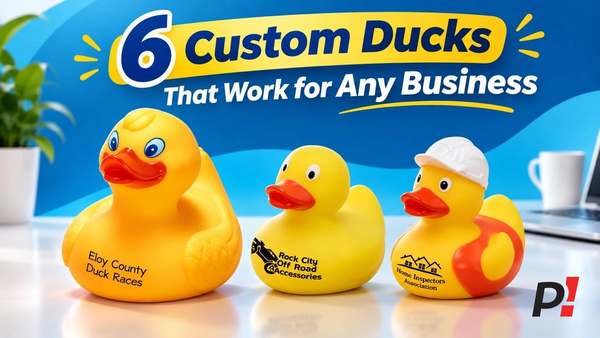
6 Custom Ducks That Work for Any Business
Custom ducks are not just for charity races. From safety reminders to trade show giveaways, here are six practical ways to put branded rubber ducks to work for your organization, plus what to decide before you order.

Are Custom Jump Ropes a Good Promotional Giveaway?
Custom jump ropes are a practical giveaway that gets used, not tossed. Learn who orders them, how to decorate them, and which styles work best for gyms, schools, and corporate wellness programs.